
Rising fuel costs are changing the way Americans think about EVs, according to ChargePoint (CHPT).
The charging operator is seeing increased usage of its chargers by standard EVs. However, the company said it’s getting a boost from an unexpected corner: plug-in hybrid (PHEV) drivers. ChargePoint’s home charging data shows PHEV owners have been charging up to 45% more frequently since March 1.
ChargePoint CEO Rick Wilmer said drivers who can choose between plugging in or stopping at a gas station are increasingly choosing the plug. Home charger sales have followed — daily unit sales doubled in mid-March and again in April compared to the six weeks prior.
“An EV is probably less than half the cost to operate for fuel,” Wilmer said in an interview with Yahoo Finance. “When you take into account service and the lack of the need for service on an EV, it gets even better from a cost of operations [standpoint].”
As new EV sales stumbled following the expiration of the federal tax credit last year, used EVs have stepped in to fill the gap. Used EV sales rose 12% year over year in the first quarter of 2026, according to Cox Automotive, as a wave of off-lease vehicles hit dealer lots at price points that rival comparable gas-powered cars.
Cox also estimates EV sales topped 85,000 units in May — the strongest month since the tax credit ended.
For ChargePoint, the distinction between new and used doesn’t much matter. “We don’t care if people get new EVs or used EVs,” Wilmer said. “What really drives our business is the cumulative number of EVs on the road.”
The infrastructure side of the business is also moving. On June 3, ChargePoint reported first quarter fiscal 2027 revenue of $102 million, up 4% year over year and ahead of guidance, with subscription revenue growing 7%.
The charging industry is competitive, however. In addition to pure-play rivals like EVgo (EVGO), Blink Charging (BLNK), and Electrify America, there’s also Tesla (TSLA). The company’s Supercharger network is the nation’s largest, and Tesla said its network grew 19% year over year in Q1.
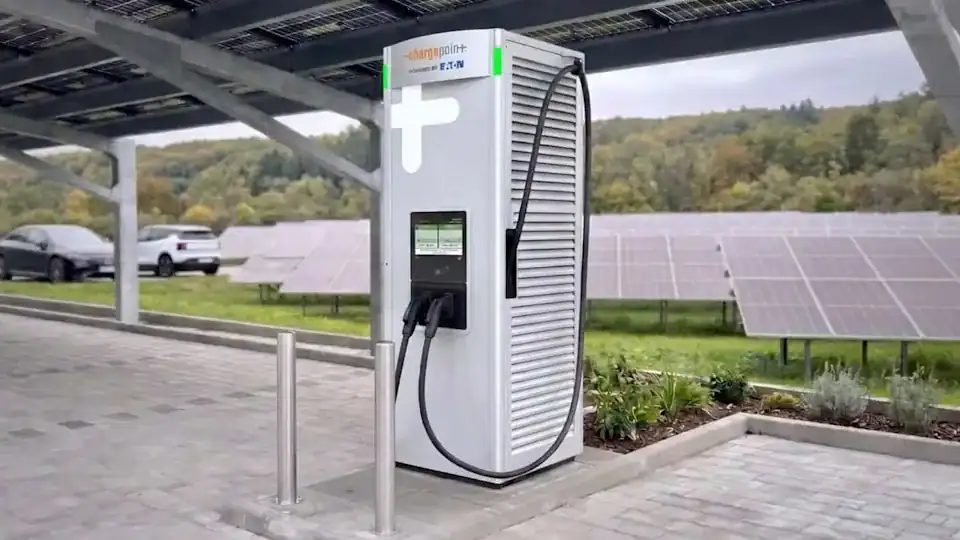
To fuel its fast charging and location build-out, ChargePoint this month launched the Express Solo, which the company called the fastest standalone DC fast charger for passenger vehicles, adding that it’s more affordable than prior chargers and comes in a smaller form factor.
Wilmer said Express Solo will hopefully alleviate the issue that most EVs are registered in cities where fast charging remains scarce, as fast-charger build-out has been focused on highway corridors.
The Express Solo’s architecture can efficiently integrate directly with battery storage and solar, and its physical footprint is designed to fit where a single gas pump might go, making the economics work for urban convenience stores and retailers that want just one charger rather than a full station.
“Using it to help someone drive their business — whether that’s attracting a tenant, a shopper, or an employee — that’s what’s really going to help drive further adoption,” Wilmer said. “Turning it into a business case rather than a moral imperative.”
Wilmer said there’s also staying power, with EV buyers growing and few defecting. More than 90% of EV owners don’t go back to gas once they’ve switched, he noted.
With used inventory cheap and fuel costs high, the window for capturing that loyalty is at its most opportune, perhaps ever. And ChargePoint is hoping to do that — one EV plug at a time.
