
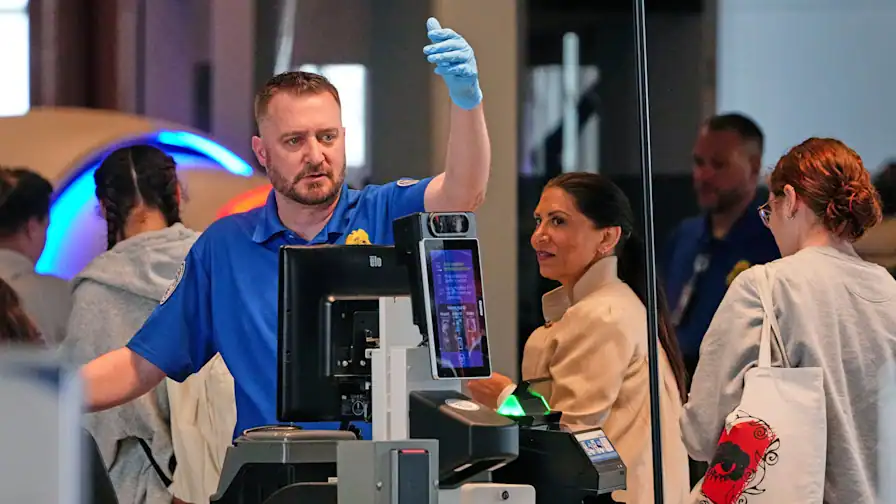
A new public-private partnership, hailed as “the future of aviation security,” is now available to airports nationwide. TSA Gold+ is the latest development in President Trump’s push to further privatize airport security screening at the Transportation Security Administration.
The news was first reported by Caleb Harmon-Marshall of Gate Access, a Yahoo creator and former TSA officer.
Earlier this year, tens of thousands of TSA workers were left without paychecks during the partial government shutdown. In April, testimony before the House Appropriations Committee, TSA deputy administrator Ha Nguyen McNeill said that the “TSA workforce and our operations cannot depend on predictable congressional funding.”
McNeill proposed handing over additional airport screening operations to private companies under the Screening Partnership Program (SPP). SPP screeners operate under the same security procedures as the TSA but are paid by private companies rather than congressional appropriations.
TSA Gold+ builds on that model. Here’s how it works, where it’s available, and how it will impact security checkpoints.
Where and how TSA Gold+ works
A TSA spokesperson confirmed the new program with Yahoo Finance, saying it was “a transformative upgrade to offer airports the opportunity to ‘opt in’ to a public-private screening model tailored to their unique needs, ensuring continuity and operational stability even during federal government shutdowns.”
TSA Gold+ is an expansion of the currently existing Screening Partnership Program. Private companies operate under contracts with the TSA, but are empowered to tailor local operations for greater efficiency and improved security.
“Public-private partnerships bring in private capital, easing financial pressure and enabling major infrastructure upgrades,” the official TSA Gold+ government website says. The companies are encouraged to innovate, streamline, and “rapidly deploy new technologies.”
Companies interested in providing security screening services and airports wishing to join the Screening Partnership Program can apply to the TSA.
Currently, 20 airports are served by SPP providers; however, that doesn’t mean they are operating under the new TSA Gold+ agreement. While San Francisco International Airport and Kansas City International are among the largest participating in the SPP, most are regional airports and those serving popular tourist destinations.
A list of new TSA Gold+ participating airports has not yet been released.
What you need to know about TSA Gold+
Initially, TSA Gold+ screenings will look and feel the same as other airport security checkpoints. Perhaps the lines will be shorter — and for travelers, that’s a win. However, as private contractors innovate and streamline their operations with improved technology, TSA Gold+ operations may become a significantly different experience.
And the shorter lines may be because smaller airports are generally the primary participants in the Screening Partnership Programs. The government’s push for privatization is not yet focused on major hubs and international airports.
The TSA noted these Gold+ benefits:
-
Airports can adopt custom screening solutions to meet their needs.
-
The adoption of new technologies can be accelerated locally.
-
Infrastructure improvements will be funded privately, reducing the taxpayer burden.
-
TSA oversight will ensure consistent security standards.
-
The program aims to “deliver faster, more efficient screening.”
-
The public-private partnerships can enable uninterrupted operations and employee pay, “regardless of federal budget cycles.”
TSA Gold+ vs. TSA PreCheck
TSA Gold+ is an operational change that converts federally staffed security points to those operated by private companies. Initially, only the screeners’ uniforms are changed. Ultimately, the aim is for security checkpoints to become more efficient and tailored to local needs.
TSA PreCheck is a service upgrade that allows passengers to bypass traditional airport security gate lines and use “express lanes.” TSA PreCheck members generally wait less than 10 minutes to clear security.
A five-year membership costs $85 or less.
How to get TSA PreCheck for free
Since credit card companies often cater to travelers, several travel and rewards cards offer free TSA PreCheck. The fee is reimbursed as statement credits or with reward points.
Global Entry vs. TSA PreCheck
Global Entry is another “skip the line” option for travelers reentering the U.S. from foreign destinations. Offered through the U.S. Customs and Border Protection, you must pass a background check and pay a $120 fee to become a five-year member of Global Entry.
