
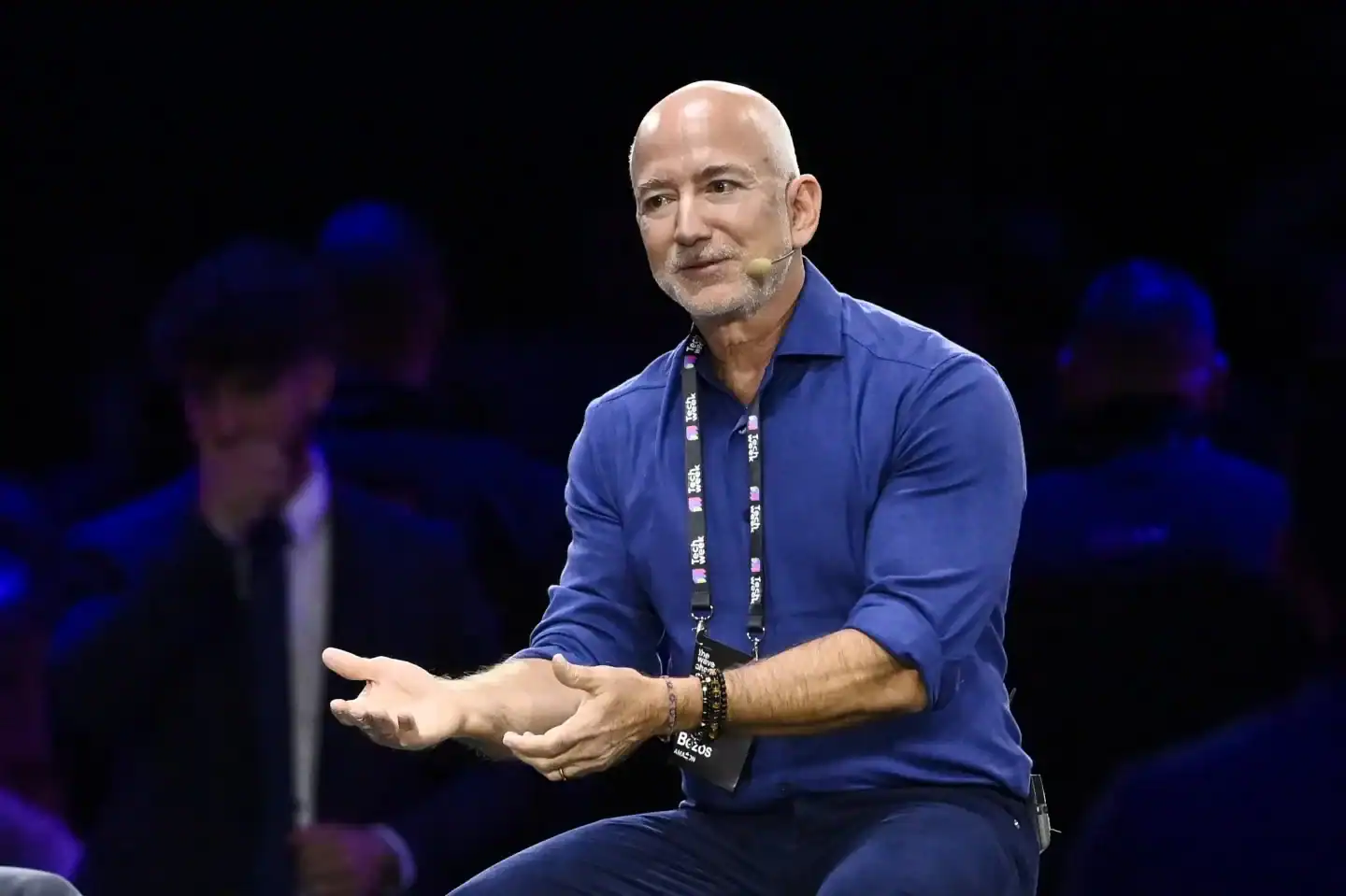
Amazon executive chairman Jeff Bezos, by some estimates the world’s fourth-wealthiest person, has turned the tables on the “tax the rich” effort. He is advocating for eliminating federal income taxes for lower-income Americans.
In an interview on Wednesday with CNBC, Bezos reflected on his upbringing as the son of a Cuban immigrant and a teenage mother, who “brought themselves up” during hard times.
“I want to make sure that the people who are struggling today have a chance to do that, too, to bring themselves up, and maybe they’re going to be the next Steve Jobs,” Bezos said. “Maybe one of their kids will be the next Steve Jobs. I don’t know, but we can give them a better chance by eliminating their tax bill.”
While Bezos also argued that raising taxes on the wealthy will do little to help struggling households, efforts to tax high earners continue to gain traction. New York City mayor Zohran Mamdani launched a “pied-à-terre” tax on luxury second homes of wealthy property owners who don’t live in the city full time. And a half dozen or more states are considering so-called “wealth taxes” as well.
‘A nurse in Queens should not pay taxes’
Bezos said that the top 1% of earners pay 40% of taxes, while the bottom half of earners pay only 3% of all tax revenue.
“A nurse in Queens who makes $75,000 a year pays more than $12,000 a year in taxes. Does that really make sense? How about we start by having the nurse in Queens not pay taxes? That’s $1,000 a month that could help with rent or groceries or anything. The bottom half of income earners in this country pay only 3% of the taxes. It’s only 3%. We can find 3%,” Bezos said.
Data from the Tax Foundation, a tax research think tank, generally aligns with Bezos’ figures. According to the organization, in 2023, the top 1% of taxpayers paid 38.4% of all federal individual income taxes, while the bottom half of taxpayers, who earn less than $53,801, paid 3.3% of the total.
“When people are starting out and they’re struggling, stop taxing them. We don’t need it. We live in the wealthiest country in the world,” Bezos said.
However, about 76 million households paid no federal income tax in 2025. According to the Tax Policy Center, 70% earned less than $75,000, and 45% earned less than $40,000. Many taxpayers used the standard deduction, as well as other exclusions and credits, such as the earned income tax credit and the child tax credit, to reduce their tax liability, the Tax Policy Center said.
The ‘Keep Your Pay Act’
There have been congressional bills floating the concept of reducing or eliminating taxes for households of modest means, though none have advanced significantly.
In March, Sen. Cory Booker (D-N.J.) introduced the Keep Your Pay Act, which would make the first $75,000 of income tax-free for households filing jointly.
“This plan can be fully paid for by unrigging our tax system — so that the wealthiest few and the biggest corporations that are getting rich by keeping prices high finally start paying their fair share,” Booker said in a statement announcing the proposal.
The bill was referred to the Senate Finance Committee, where it remains.
A half-million dollars in taxes over a lifetime
While families of modest means surely would applaud a no-federal-income-tax initiative, their tax bills wouldn’t disappear. There are still state and local income taxes, payroll taxes, sales taxes, property taxes, capital gains taxes, and excise, estate, and gift taxes.
An estimate compiled by Paradigm Life Insurance listed 97 different taxes in the U.S. tax code, including:
-
Air Transportation Taxes
-
Biodiesel Fuel Taxes
-
Building Permit Taxes
-
Business Registration Fees
-
Cigarette Taxes
-
Driver’s License Fees
-
Fishing License Taxes
-
Gasoline Taxes
-
Hotel Taxes
-
Hunting License Taxes
-
Inspection Fees
-
Inventory Taxes
-
Library Taxes
-
Liquor Taxes
-
Local School Taxes
-
Professional Licenses And Fees
-
Toll Booth Taxes
-
Self-Employment Taxes
-
Vehicle Registration Taxes
-
Workers Compensation Taxes
And that’s not a complete list.
Self, a financial technology company, estimates that the average American will pay over $520,000 in taxes in their lifetime — a third of all earnings. That includes income taxes, property taxes, and taxes on everything from everyday expenses to the cost of driving the most popular vehicle (a Toyota RAV 4, which costs $38,889 in taxes alone, based on an average of four purchased over a lifetime).
“However, due to local property markets, salaries, and government actions, some states see taxpayers paying even more than the national average,” the analysis said.
New Jersey residents pay the most taxes over their lifetimes ($987,117), while those living in West Virginia pay the least ($358,407), according to the Self report.
