
The stocks of the world’s largest energy operators gained ground Monday as traders priced in a potential new market for the companies following the United States’ capture of Venezuelan leader Nicolás Maduro.
Shares in US oil majors ExxonMobil (XOM) and ConocoPhillips (COP) both picked up 2% and 3%, respectively, while Chevron (CVX), the only US oil company left operating in Venezuela, rallied by around 6%. Oil field services giants Baker Hughes (BKR), Schlumberger (SCL.SG), and Halliburton (HAL) did much the same, gaining more than 5% each.
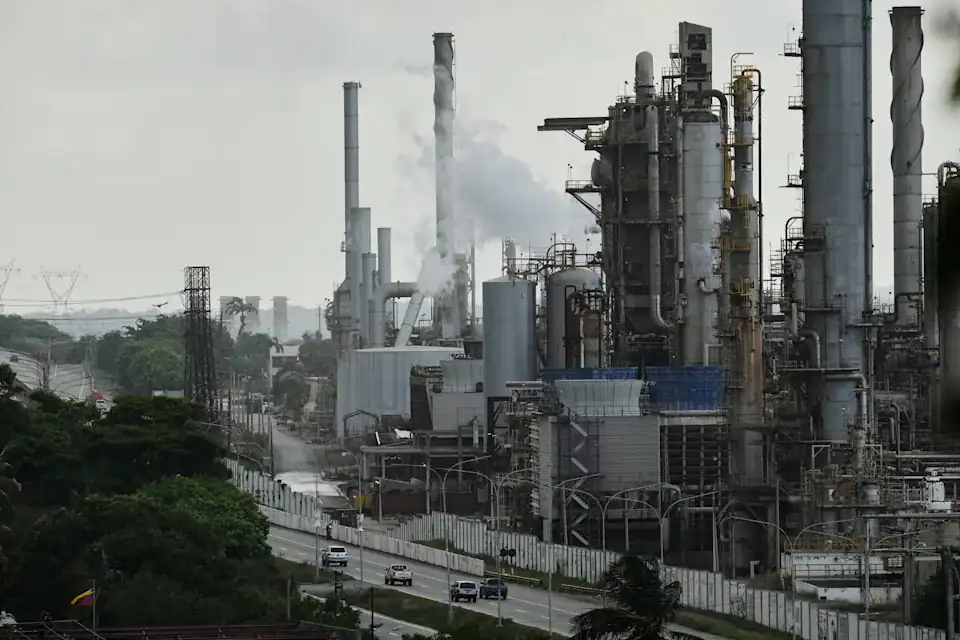
But for the oil majors and their compatriot oil field services operators, Venezuela is unlikely to be a story of immediate barrels and instead one of a slow rebuilding of infrastructure largely left to crumble for more than two decades.
“Any meaningful supply increase [of Venezuelan oil] will be gradual, require political stability, lifting of US sanctions and external investment but would add to a market where oil price has averaged down for three years,” Jefferies equity analyst Mark Wilson, who focuses on the energy market, wrote in a note to clients.
Leading up to the turn of the century and the rise of leftist leader Hugo Chavez, Venezuela was an oil powerhouse on the global stage. The South American country sits on the world’s largest proved reserves of crude oil, estimated at more than 300 billion barrels’ worth. In the 1990s and early 2000s, Venezuela was exporting more than 3 million barrels of crude oil per day (bpd).
Twenty years later, exports have dipped below 1 million bpd, falling even further as sanctions from the US Treasury Department on oil tankers have made Venezuelan crude even less attractive to global buyers. Meanwhile, the US exported more than 4 million bpd in October.
In the two decades separating Venezuela’s export highs from its current levels, the country’s oil industry has been beaten down by chronic underinvestment, corruption, and a state control model that has largely let infrastructure rot.
In Venezuela’s oil fields, rigs have fallen apart and been robbed by thieves, while spills go unmanaged. At the country’s ports, infrastructure has fallen into such disrepair that it can take up to five days to load a supertanker where once it took only one day, according to Bloomberg.
Venezuela has also suffered a large-scale “brain drain,” as a once vibrant and specialized oil workforce has spent the past decade leaving the country for other, more stable and higher-paying markets such as Houston and the Middle East.
In sum, a rebuild of Venezuela’s oil industry will not be simple by any means. Looking at potential capital expenditures alone, President Trump said he expects the US oil industry to spend billions of dollars on the effort.
“If things stabilize, a new government comes, the situation really improves and there’s no risk of a coup or anything like that, then gradually, with a lot of investment, the country could open up, but I don’t think it’s a matter of a few months,” Jorge León, head of geopolitical analysis at Rystad Energy, told Yahoo Finance. “I think we’re talking about years.”
‘The fallen angel of global crude markets’
The oil majors have spent the past several years in a period of major de-risking, shrinking portfolios and shying away from new investments — especially in precarious frontiers — as oil prices have fallen and margins have shrunk.
Those companies are likely to be loath to enter Venezuela until they can be assured of a more stable operating environment, Carlos Bellorin, executive vice president of energy trends and analysis at the intelligence firm Welligence, said.
“They will be reluctant [to enter Venezuela] especially in these early months, early years of this transitional government,” Bellorin told Yahoo Finance. “Their finances are not great, they’ve been trying to relinquish non-core areas, and ultra-focus on their portfolio — they’re risk averse.”
The wild card, Bellorin said, will be whether the US majors receive pressure from the Trump administration to enter Venezuela as part of Trump’s stated goal to rebuild the oil economy and begin shipping those barrels to US shores.
Upstream on the ground in Venezuela, oil field services companies may be poised to perform well. After the United States’ 2003 invasion of Iraq, it was services giant Halliburton, through its subsidiary Kellogg Brown & Root, that was granted massive government contracts to perform the risky work of entering a war-torn environment to stabilize and rebuild Iraq’s oil infrastructure.
In Venezuela, it is likely to be the oil field services companies that are able to assess, rebuild, and upgrade equipment to bring the oil fields and export infrastructure back to workable levels, especially if the US intends to markedly strengthen Venezuela’s industry, Bellorin said.
“You need more than ever the Schlumbergers, the Halliburtons, the Baker Hugheses in order to increase and maintain production,” Bellorin said.
The American refining industry could also stand to gain. Heavy, sulfurous crude oil accounts for roughly 50% to 60% of US crude imports, given that much of the oil found throughout the United States is the lighter, sweeter grade of the shale patch.
Much of the United States’ refinery capacity — especially along the Gulf Coast, where refining is a booming industry — is designed to handle and process heavy sour crude, ideal for oil that could begin to flow from what Mizuho analyst Nitin Kumar called “the fallen angel of global crude markets” in a note to clients.
The move by Trump to take control of Venezuela’s oil could offer a cheaper substitute for Canada, which accounts for the majority of US oil imports, including most of US refiners’ heavy crude imports.
Shares in major US refiners rallied Monday. Marathon Petroleum Corporation (MPC), the largest refiner in the US by capacity, picked up more than 5%, while fellow refining giants Phillips 66 (PSX) and Valero Energy (VLO) gained more than 6% and more than 9%, respectively.
Perhaps the largest potential winner, Bellorin said, will be Chevron, the only US oil company to remain active in Venezuela throughout the unrest caused by the Chavez regime. Chevron also has the benefit of vertical integration, with operations throughout the upstream producing, midstream transport, and downstream refining sectors.
“They played the long game, and they won,” Bellorin told Yahoo Finance.
“They have the best relationship with [interim president Delcy Rodríguez] and the rest of the government, they know the land, they know the people, they know the geology, and they are going to expand their operations, at least at the beginning, and will establish their production in their own projects.”
Regardless, any build-up and serious remaking of Venezuela will take time, several analysts told Yahoo Finance, and it will require buy-in from the US oil industry, which is already facing its own deep headwinds.
And this is all coming at a moment when the global energy market is facing a steep oil supply glut — pegged at more than 3 million bpd by the International Energy Agency — that is widely predicted to depress prices and tighten margin through at least the end of 2026.
If the political risks are to stabilize and major oil companies are to embrace operating once more in Venezuela, the country may see its exports stabilize and recover back up to around 1 million to 1.5 million bpd in the next one to two years, Bellorin said.
If the situation takes a bit longer to stabilize, Venezuela may be looking at a three- to five-year timeline before reaching exports at the level of 2 million bpd, León told Yahoo Finance.
“I doubt international oil companies will rush back into the country, particularly in a period right now of an oversupplied market with lower prices on the horizon,” León said.
“[Rebuilding Venezuela’s oil infrastructure] is not going to be easy, it’s not going to be fast, and it’s not going to be cheap.”
