
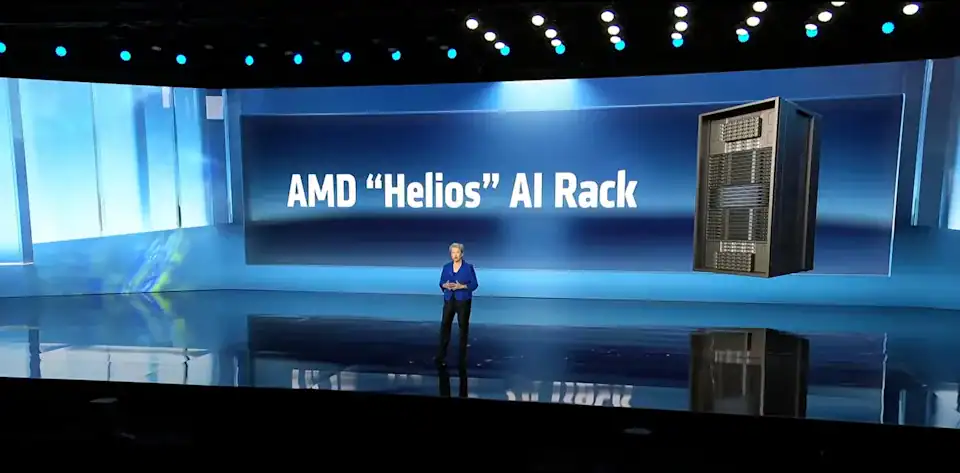
AMD (AMD) CEO Lisa Su unveiled the company’s upcoming AI data center platform during her keynote at CES 2026 in Las Vegas on Monday, providing a first look at the Helios system and offering more details about how it will be built.
Su not only brought out a large Helios rack unit on stage, but also said it was the “world’s best AI rack,” a direct shot across Nvidia’s bow.
Nvidia (NVDA) has set the standard for rack scale systems and debuted its latest offering, the Vera Rubin NVL72, at CES on Monday.
Helios will go head-to-head with Nvidia’s own NVL systems, matching its latest NVL72’s 72 Rubin GPUs with 72 of AMD’s MI455X chips. It’s another sign that AMD is working to move further in on Nvidia’s turf in the AI data center market.
The company expanded on that effort by providing more information about its upcoming MI500 series data center GPUs, which AMD boldly declares will provide up to a 1,000x increase in AI performance compared to its MI300X GPUs.
According to Su, that kind of performance jump will be necessary over the coming years. During her keynote, the CEO said AMD believes some 5 billion people will be using AI every day in the next 5 years, and to meet that demand, technology companies will need to increase global computing capacity by 100 times in the coming years.
That kind of growth could undoubtedly benefit AMD and Nvidia.
AMD has benefited handsomely from both its AI data center businesses over the last year. The company’s stock price increased 76% over the last 12 months, outpacing even that of Nvidia, which rose 30%.
Still, Nvidia continues to dominate the AI industry, increasing its market capitalization to $4.5 trillion. AMD’s market cap sits at $359 billion.
Like Nvidia and Intel (INTC), AMD also showcased its work in the robotics space, with Su bringing Generative Bionics CEO Daniele Pucci on stage to unveil the company’s humanoid robot for the first time.
Powered by AMD’s CPUs and GPUs, the robot, dubbed GENE.01, is meant to operate in industrial environments. AMD is an investor in Generative Bionics.
On the PC front, Su announced that AMD’s latest Ryzen AI 400 Series and Ryzen AI Pro 400 series chips will take on Intel’s new Core Ultra 3 processors built on its new 18A process technology.
According to AMD, the chips come with up to 12 high-performance CPU cores for consumers that need oodles of processing power, as well as AMD’s integrated Radeon 800M series graphics chips, and an NPU with up to 60 TOPs of performance. TOPs, or trillions of operations per second, are a means for measuring AI processing performance.
All of that, the company says, means users can expect multi-day battery life and strong AI and gaming capabilities.
The company also showed off its latest Ryzen AI Max+ chips for premium light laptops, workstations, and mini-PCs, as well as its new Ryzen AI Halo developer platform. Essentially a mini desktop PC, the computer is designed to help developers build AI models locally rather than in the cloud.
The Halo developer platform goes up against Nvidia’s rival DGX Spark mini-PC, which costs $3,999. AMD didn’t reveal pricing for Halo.
