
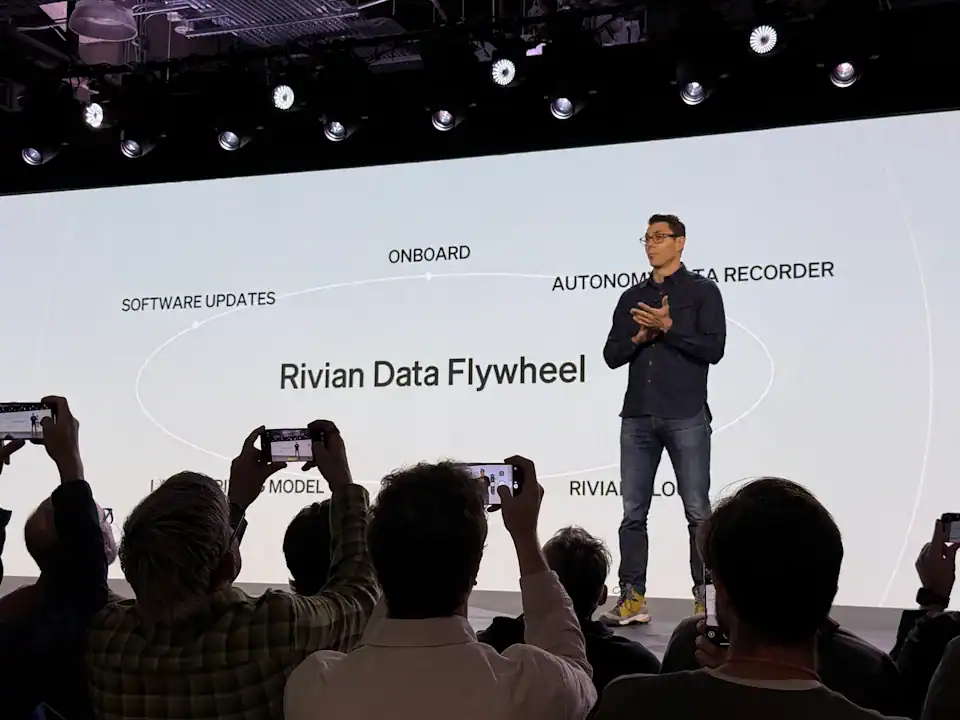
Rivian (RIVN) stock soared on Friday, a day after the company’s Autonomy & AI day, where CEO RJ Scaringe agreed that an inflection point on self-driving was near.
The company said software advancements from its new Autonomy platform and Large Driving Model (LDM), an autonomous model trained similarly to a large language model (LLM), will expand its Universal Hands-Free (UHF) assisted driving to second-gen R1 vehicles, covering 3.5 million miles in the US.
In 2026, a point-to-point hands-free system will be released, followed by a hands-free and eyes-free self-driving product, with the ultimate goal of achieving “personal Level 4” autonomy, meaning the vehicle will be able to drive fully on its own without requiring the driver’s attention.
“We realized we wanted to do a clean-sheet approach to our Autonomy platform, and so we started the process on that, and that involved developing a camera platform, so a perception platform, redesigning the compute platform, and really architecting the whole system around an AI-centric approach, where the vehicles that are on the road are part of a large data flywheel, where we’re collecting data and using that data to train the models,” Scaringe told Yahoo Finance at the Rivian event.
Rivian stock jumped to a new 52-week high and closed up 12.1%, boosted by bullish sentiment and Wall Street commentary.
Part of the company’s AI-centric approach means making its own chips, known as the Rivian Autonomy Processor (RAP1), which will power Rivian EVs’ self-driving capabilities. This contrasts with the company’s previous approach of using Nvidia’s Orin chip in its self-driving computer module.
Wall Street reacted positively to Rivian’s approach to tackle autonomy with custom silicon and in-house developed autonomy software.
“RIVN signaled a shift from an OEM [original equipment manufacturer] adopting autonomy to one leveraging AI to build end-to-end autonomy,” Needham analyst Chris Pierce wrote in a note to investors on Friday.
Pierce said the company’s in-house developed silicon, compute architecture, and vertically integrated autonomy platform will drive a “separation vs. legacy OEMs still dependent on third party suppliers.”
Pierce reiterated his Rivian Buy rating and pushed his price target considerably to $23 from $14, a 64% jump. Pierce believes Rivian can drive faster iterations and cost optimizations, building a competitive advantage.
Pierce concluded that the real payoff will come in 2027, when the company will have its R2 vehicle in full production, costing around $50,000 and offering “eyes-off” and point-to-point self-driving.
